
Fragrance Allergen Labelling Mistakes That Cost a Value Line Its Launch
The most expensive allergen labelling mistake on a value line is not a missing substance; it is a label that was treated as a design asset until the last week of the project. Value lines iterate packs quickly, reprint often and change contract manufacturers more readily than premium lines, and all three habits raise the chance that an allergen declaration is copied from an earlier product. The six mistakes below account for most of the reprints, and each one has a fix that costs almost nothing when it is applied at the brief stage.
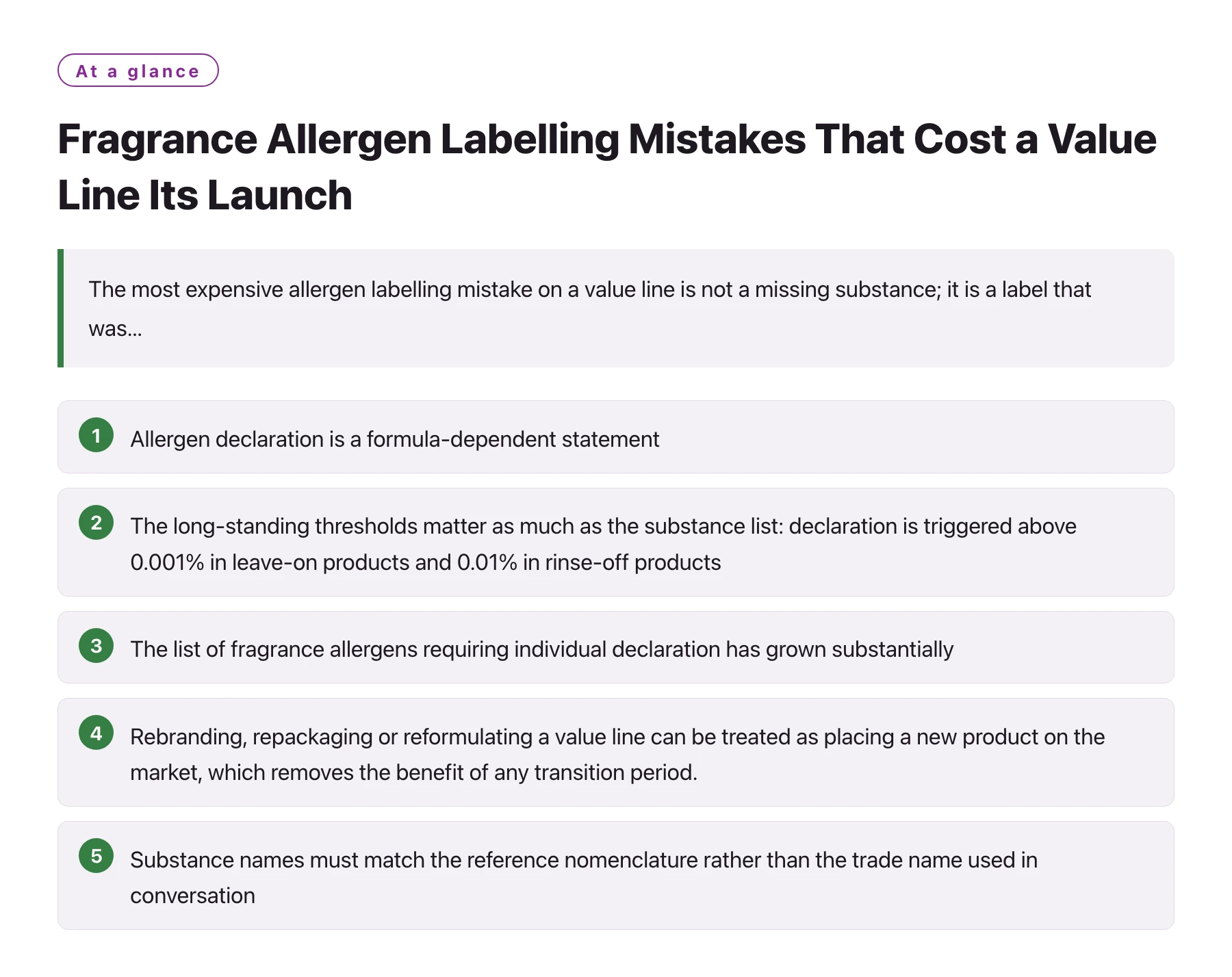
Key takeawaysAllergen declaration is a formula-dependent statement, so a label copied from a sister product is a compliance claim that has not been verified. · The long-standing thresholds matter as much as the substance list: declaration is triggered above 0.001% in leave-on products and 0.01% in rinse-off products, and a change of format can move a product across that line. · The list of fragrance allergens requiring individual declaration has grown substantially, so a label template written a few years ago is probably out of date [1]. · Rebranding, repackaging or reformulating a value line can be treated as placing a new product on the market, which removes the benefit of any transition period. · Substance names must match the reference nomenclature rather than the trade name used in conversation, because reviewers check names, not intentions [2]. · The most reliable control is to hold the allergen statement as a controlled document tied to a formula version, not as text inside an artwork file.
Allergen labelling looks like a small line on the back of a carton. On a value line it is often the item that decides whether a launch ships on time, because the declaration depends on the formula, the formula depends on the supplier, and the supplier's documentation arrives later than the artwork deadline.
The six mistakes that follow are ordered by how much they cost to fix once they are discovered. All of them are cheaper to prevent than to correct, and none of them require a compliance department to avoid.
Six mistakes, where they start, and the fix
| Mistake | Where it starts | The fix |
|---|---|---|
| Copying the declaration from a previous product | Artwork reuse under time pressure | Tie the allergen statement to the formula version and re-issue it whenever the formula changes |
| Using trade names instead of reference names | Briefs written in marketing language | Request the declaration in reference nomenclature and check it against the ingredient database |
| Ignoring the format change | A body mist added to a perfume range | Re-check thresholds for each format: leave-on and rinse-off rules are not the same |
| Assuming a transition period applies | A pack refresh or a reformulation | Confirm whether the change counts as a new product before relying on any deadline |
| Leaving the declaration to the printer | Artwork handover without a data sheet | Send the approved declaration with the artwork and require a proof check against it |
| Holding only the label, not the evidence | Files kept by the artwork team | Keep the supporting declaration and formula reference in the product file, not in a design folder |
Each row is a control point. A buyer who names the control owner for each one has effectively built the labelling process for the line.
Thresholds and formats: the mistake that hides in plain sight
The declaration rules are threshold-based. A fragrance material that must be declared in one product may fall below the trigger in another, and the difference is often simply whether the product is rinsed off or left on the skin. This is why a value range that spans a perfume, a body mist and a hand wash needs three separate reviews even when all three use the same concentrate.
The practical implication is that allergen compliance cannot be approved once for a family of products. It should be approved per formula and per format, and the approval should record the concentration as well as the substance. When a supplier later adjusts a dosage to control cost, that adjustment can move a material across a threshold, and the label has to move with it.
It is also worth remembering that the thresholds are not a target to design against. A formula engineered to sit just under a trigger is fragile: a small change in dosage, a reformulation for supply reasons, or a switch to a different compound can push it over. Building a clear margin into the declaration is usually cheaper than managing the edge.
What changed, in one paragraph
The European Union substantially expanded the list of fragrance allergens that must be declared individually on cosmetic labels, moving from a short list of well-known materials to a much longer one, with staged transition dates for products already on the market. A template written before that change will under-declare, and under-declaration is not corrected by adding a warning line at the bottom of the pack [1].
Controls that survive a supplier change
Value lines change suppliers more often than premium lines, and each change resets the documentation pipeline. The defence is to make the allergen statement a controlled document with a version number, a formula reference and a named owner, so that a new supplier is asked for a specific artefact rather than a general reassurance.
Ask for the statement in writing, in the reference nomenclature used for labelling, and keep it with the safety documentation rather than in the artwork folder. The European ingredient database is a useful cross-check for substance names and restrictions when a supplier's spelling looks unfamiliar [2]. Reviewers compare names literally, so a variation that reads as a synonym to a human can read as a missing declaration to a system.
The final control is a proof check against the approved data. Printers reproduce what they are sent, and artwork teams reproduce what they are given. A short, signed comparison between the approved declaration and the printer's proof closes the loop, and it is the step that most often catches a value line's mistake before the cartons exist. Asking how a manufacturer handles this is a fair question in any supplier conversation, and the answer should match what the operation publishes on the fragrance manufacturer's website rather than what a sales deck promises.
Where the line is produced by a contract manufacturer, agree who owns each step: who requests the declaration, who verifies it, who holds the evidence and who signs the artwork off. Splitting those four responsibilities across three companies without naming them is how a declaration ends up approved by nobody, and how a value line ends up paying for a second print run. The same discipline applies on the production side, where the declaration has to be traceable to the batch that was filled, not only to the formula that was approved; a partner that documents safety testing in perfume manufacturing as a routine usually has that traceability already built into its paperwork.
None of this is exotic. It is a version-controlled document, a named owner and a proof check. The reason value lines still get it wrong is that each of those three things is somebody's second priority until the label is at the printer.
One question settles whether a supplier can support allergen labelling properly: "Can you send the declaration for this formula in the reference nomenclature, tied to the version we are approving?" A supplier that answers with a document has the process. A supplier that answers with a sentence has a habit, and habits do not survive a formula change.
Sources
- HPRA: Labelling of cosmetic fragrance allergens
- EU CosIng — Cosmetic Ingredient Database (European Commission) —— The European Commission's CosIng database of cosmetic ingredients, listing ingredient functions, restrictions and labelling requirements under EU cosmetics law.
Frequently asked questions
Do fragrance allergens have to be listed on every cosmetic label?
Only when they are present above the applicable threshold, and the threshold differs between leave-on and rinse-off products. The substance list and the thresholds are both defined by the cosmetics rules of the market where the product is sold, so the label must be assessed per formula, per format and per market.
Why is copying a label from a similar product a problem?
Because the declaration describes a specific formula and format. Even a small dosage change can alter which materials cross the declaration threshold, so a copied label is an unverified claim rather than a shortcut.
Does rebranding a value line affect its allergen labelling obligations?
It can. Rebranding, repackaging or reformulating may be treated as placing a new product on the market, which can remove the benefit of a transition period for products already on sale. Check the position for your market before assuming an old label can be reused.
Who should own the allergen statement inside a brand?
One named person, usually in product development or quality, with the artwork team receiving an approved document rather than drafting the text. Ownership matters more than the department, because the failure mode is a statement that nobody was responsible for verifying.
How often should an allergen declaration be reviewed?
Whenever any of four things changes: the formula, the format, the supplier or the destination market. If none of them has changed, an annual review is usually enough, but the trigger-based review is the one that prevents reprints.